
Closure Of Regular Languages
Closure Of Regular Languages - Web using closure properties to prove that languages are regular. \(l_1 \cap l_2 = \overline{\overline{l_1} \cup \overline{l_2}}\) (2) \(l_1\) and \(l_2\) are regular. Regular languages are closed under intersection. Union and intersection are examples. Web the regular languages are closed under various operations, that is, if the languages k and l are regular, so is the result of the following operations: Consider regular languages l1 and l2.
Consider regular languages l1 and l2. Regular languages are formal languages that regular expressions can describe and can also be recognized by finite automata. Theorem 4.1 if l1 and l2 are regular languages, then. Union and intersection are examples. Closure properties on regular languages are defined as certain operations on regular language that are guaranteed to produce regular language.

Closure Properties of Regular Languages ppt download
Web a closure property of a language class says that given languages in the class, an operator (e.g., union) produces another language in the same class. Regular languages are closed under intersection. A significant question within the domain of formal languages is whether a given language is regular. Closure refers to some operation on a language, resulting in a new.
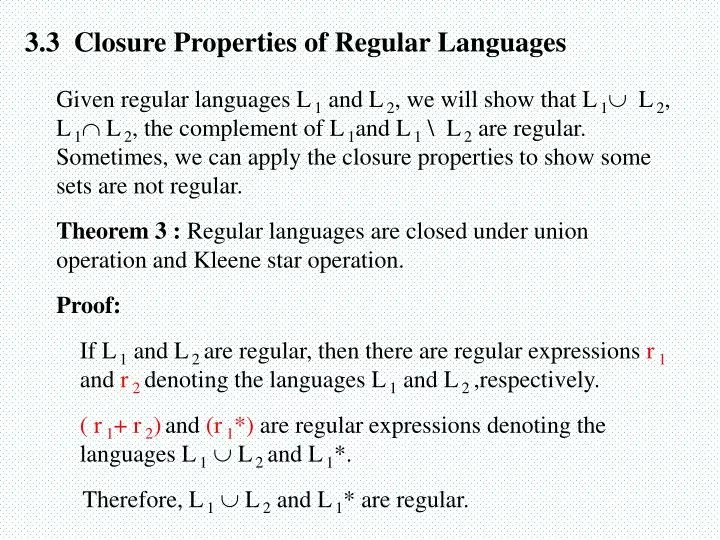
PPT 3.3 Closure Properties of Regular Languages PowerPoint
Regular languages are formal languages that regular expressions can describe and can also be recognized by finite automata. Web using closure properties to prove that languages are regular. \(l_1 \cap l_2 = \overline{\overline{l_1} \cup \overline{l_2}}\) (2) \(l_1\) and \(l_2\) are regular. Closure refers to some operation on a language, resulting in a new language that is of. $ (closure under.

Regular Languages Brilliant Math & Science Wiki
Regular languages and finite automata can model computational. Are regular languages, then each of. Closure refers to some operation on a language, resulting in a new language that is of. Web in an automata theory, there are different closure properties for regular languages. Theorem 4.1 if l1 and l2 are regular languages, then.

Closure Properties of Regular Languages Let L and M be regular
Web the regular languages are closed under various operations, that is, if the languages k and l are regular, so is the result of the following operations: This page summarizes closure properties for regular languages and how to exploit them. 3.4 dfa proofs using induction. Closure refers to some operation on a language, resulting in a new language that is.

Closure of CFL against rightquotient with regular languages (3
Web a closure property of a language class says that given languages in the class, an operator (e.g., union) produces another language in the same class. Web closure of regular languages (1) ¶. Theorem 4.1 if l1 and l2 are regular languages, then. Web using closure properties to prove that languages are regular. Union and intersection are examples.
Closure Of Regular Languages - Web closure closure properties properties of of a a set set. Web a closure property of regular languages is a property that, when applied to a regular language, results in another regular language. • for any language l. A set is closed over a binary operation if,. Web the term that describes the property of operators “staying within the same class of language” is called closure; Web closure properties of regular languages ¶.
Pumping lemma for regular languages for every regular language a, there exists an integer p % 0 called the. Web the regular languages are closed under various operations, that is, if the languages k and l are regular, so is the result of the following operations: Just as integers are closed under addition, subtraction, and. Consider regular languages l1 and l2. The set of regular languages is closed under each kleene operation.
Web Using Closure Properties To Prove That Languages Are Regular.
Web closure of regular languages. Theorem 4.1 if l1 and l2 are regular languages, then. Web the term that describes the property of operators “staying within the same class of language” is called closure; Web closure of regular languages (1) ¶.
Union And Intersection Are Examples.
Relationship with other computation models. $ (closure under ∘) recall proof attempt: This page summarizes closure properties for regular languages and how to exploit them. Web in an automata theory, there are different closure properties for regular languages.
Web The Regular Languages Are Closed Under Various Operations, That Is, If The Languages K And L Are Regular, So Is The Result Of The Following Operations:
In this module, we will prove that a number of operations are closed for the set of regular languages. 3.4 dfa proofs using induction. “the “the set set of of integers integers is is closed closed under under addition.” addition.”. Web closure closure properties properties of of a a set set.
Web A Closure Property Of A Language Class Says That Given Languages In The Class, An Operator (E.g., Union) Produces Another Language In The Same Class.
Web a closure property of regular languages is a property that, when applied to a regular language, results in another regular language. The set of regular languages is closed under each kleene operation. Recall a closure property is a statement that a certain operation on languages, when applied to languages in a class. Consider regular languages l1 and l2.